Summer is a time to kick back, relax, and read a whole bunch of game studies scholarship, right?
Starting in a few weeks, I’ll be facilitating a summer game studies reading group for our Ph.D. students here at UC Irvine, many of whom already study games or are just getting into the field. We’ve got folks from Informatics, my department, but also Anthropology, Visual Studies, and more. The goal is to meet once a week and build a shared vocabulary around games by reading and discussing texts together.
Inspired by Adrienne Shaw’s presentation here at the UC Irvine Critical Game Studies Conference in the spring, our topic for this summer’s reading group is “canons and counter-canons.” Here were my design goals in putting together reading list, as they’re laid out on our community document:
1. To offer grad students a crash course in the big names of game studies — not so that they can replicate longstanding issues of citing and re-citing the same limited (and privileged) voices, but so that they can be conversant and therefore “legitimate” in the field, and building from that legitimacy disrupt and reimagine game studies in their own work. We might call this the “canon” of game studies, but definitely note the air quotes.
2. To highlight the work of key voices in game studies whose work has often gone overlooked or undervalued, with a special emphasis on non-cis-male scholars, scholars of color, queer scholars, and others invested in social justice — with the hope of encouraging students to see game studies as a field that is diverse, complex, and ripe for dissent. We might call this a counter-canon of game studies: not a perfect metaphor, but you get the idea.
3. To bring a selection of contemporary works addressing culture, history, identity, social justice and (broadly speaking) the social contexts and meanings of video games into dialog with these earlier works.
Hopefully the UCI summer game studies reading group will become an annual tradition!
 Back in March, I had the wonderful opportunity to give an invited guest talk as part of the
  With assistance from some amazing students and peers, I put together this helpful, friendly
  This March, at the Society of Cinema and Media Studies Conference in Chicago, Teddy Diana Pozo, Whitney Pow, and I put on a pretty rad panel that explored the relationship between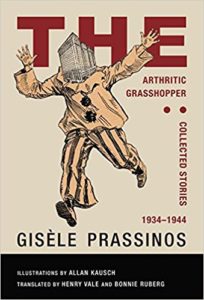
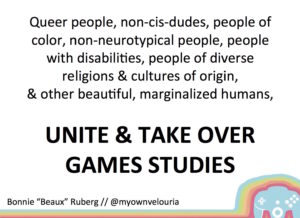 Thanks very much to my co-panelists Edmond Chang, Evan Lauteria, and Timothy Welsh for a wonderful round table at the 2017 Popular Culture Association & American Culture Association Conference in San Diego this weekend!
 It’s been a few years since my last trip to the
 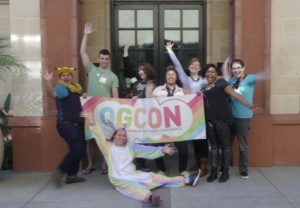 The 4th annual Queerness and Games Conference (QGCon) took place in Los Angeles this weekend, and I’m very happy to say that it was a huge success. QGCon 2017 was hosted by my very own